AI Video Ads vs. Traditional Production: Which One Actually Grows Your Business?
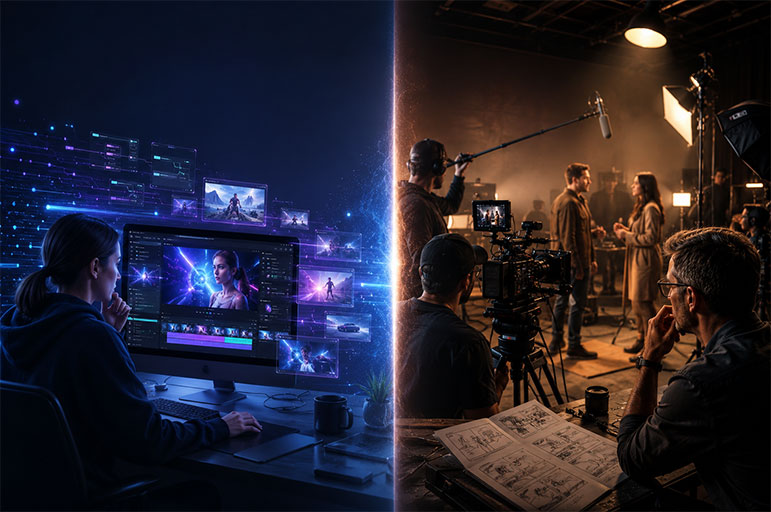
A few years ago, if you told a marketing director they could launch a cinematic product ad without a camera, a location, or a single actor, they'd have laughed you out of the room. Today it's a Tuesday afternoon decision.
That shift has created a real question for every founder, marketer, and agency I talk to: should your next campaign be built with AI, filmed the traditional way, or something in between?
I've spent years on both sides of this — cutting footage from real shoots in After Effects and Premiere, and more recently, directing fully AI-assisted campaigns from concept to final export. So let me save you the trial and error. The honest answer isn't "AI is the future, traditional is dead," and it isn't "AI is a gimmick, nothing beats a real camera" either. The right answer depends entirely on what your ad needs to prove to the person watching it.
Let's break it down properly.
What "AI Video Ads" Actually Means (It's Not What Most People Think)
Here's the biggest myth I run into: people assume an AI video ad is one prompt, one click, one export. That's the demo-reel version, not the professional one.
A real AI-powered production still involves a full creative process — concept development, prompt refinement, shot selection, compositing, motion graphics, color grading, sound design, and a lot of quality control to fix the things AI still gets wrong (and it does get things wrong).
There are two flavors worth knowing:
- Fully AI-generated video — nearly everything, from characters to environments to motion, comes from generative tools. Great for short, stylized, or conceptual social content.
- AI-assisted video — generated visuals are blended with real product footage, screen recordings, custom motion design, and human creative direction. This is where most professional, client-ready work actually lives.
The second category is where I spend most of my time, because it gives brands the imagination of AI without sacrificing the control and credibility that clients expect.
Where the Real Savings (and Real Costs) Are
Cost is usually the first question every client asks me, so let's be straight about it.
AI removes a lot of the physical expenses of production — no location fees, no travel, no actor buyouts, no crew catering, no reshoot days because it rained. That's real money saved.
What it doesn't remove is the need for skilled creative work. Someone still has to write the concept, direct the visual style, generate and cull hundreds of shots, fix distorted product packaging, correct a logo that morphs mid-scene, and edit everything into something that actually tells a story instead of looking like a tech demo. That craft is where the value — and the cost — genuinely lives.
Traditional production, on the other hand, has a more predictable but structurally higher budget. You're paying for people's time: a director, a crew, actors, a studio, insurance, wardrobe, and the very real risk of a reshoot if something goes wrong on set.
The pattern I see across projects:
- Visually ambitious, imaginative concepts → AI-assisted wins on cost, easily.
- Real customer testimonials or founder stories → traditional wins, and honestly, AI shouldn't be trying to replace this.
- Multiple ad variations for testing → AI scales efficiently; traditional gets expensive fast.
- Precise physical product demos → traditional is simply more dependable.
Speed: Faster, But Not Instant
AI production can dramatically shorten the runway between "idea" and "launch," because there's no casting, no location scouting, no travel schedule to coordinate. Adobe's 2026 research on AI and digital trends found that a majority of organizations reported real improvements in the speed and volume of their content production once they adopted generative tools — and that lines up exactly with what I see on client projects.
But here's what I always tell people before they hire me: AI isn't instant. A polished AI-assisted ad still takes real time — developing the concept, keeping characters visually consistent, running and discarding dozens of generations, cleaning up artifacts, building motion graphics, mixing sound, and cutting formats for every platform. It's faster than a traditional shoot in most cases, but it's still craftsmanship, not a vending machine.
Where AI Shines — and Where It Still Struggles
Modern AI video is genuinely impressive when the concept is cinematic, surreal, or otherwise impossible to film cheaply. A SaaS product floating through a futuristic cityscape. An abstract cybersecurity threat visualized as a digital storm. A luxury studio environment that would cost a fortune to build in real life. This is AI's home turf, and it's why I lean on it heavily for tech and SaaS clients.
Where it still stumbles: hands, consistent faces, natural eye movement, and products that stay perfectly identical shot to shot. If a bottle label shifts or a logo warps slightly between frames, most viewers won't consciously notice — but something will feel off, and that quietly erodes trust in the brand.
That's exactly why traditional filming still wins for testimonials, founder-led videos, real product demonstrations, and anything where genuine human emotion is the whole point of the ad. A real person's face, tone, and body language carry a kind of trust that synthetic content hasn't fully earned yet — and in trust-sensitive categories like healthcare or finance, that gap matters a lot.
A Beautiful Video Isn't the Same as a Result
This is the part clients sometimes forget: neither AI nor traditional production guarantees conversions. A gorgeous ad with a weak hook, an unclear offer, or the wrong audience will underperform no matter how it was made.
What AI-assisted production genuinely improves is testing. Because you're not paying for a full reshoot every time, you can produce multiple hooks, multiple visual directions, different calls to action, and platform-specific cuts — vertical for Reels and TikTok, square for feed, horizontal for YouTube — without blowing up the budget. For paid social especially, where creative fatigue sets in fast, that flexibility is a real competitive edge.
Traditional production earns its keep in a different way: through authenticity that's hard to fake. A real customer describing how a product solved their problem, filmed with genuine emotion, often converts better than the most polished synthetic presenter — because people can tell the difference, even if they can't say exactly how.
So Which Should You Choose?
Lean toward AI-assisted production if:
- Your concept would be expensive or impossible to film for real
- You need several creative variations to test
- You're launching fast and can't wait on a full production schedule
- Your product is digital, abstract, or doesn't physically exist yet
- You want a cinematic, imaginative brand world without a blockbuster budget
Lean toward traditional production if:
- Real human trust is the core of your message
- You need authentic testimonials or founder-led storytelling
- Your product must be shown with total physical accuracy
- Your industry is regulated or your audience is skeptical of synthetic content
And honestly — most of my best client work lives in between. A hybrid approach, where an AI-generated environment sets the emotional tone, real product footage proves it works, and motion graphics tie it all together, tends to outperform either extreme on its own. It's how you get the imagination of AI without losing the credibility that makes people trust your brand enough to buy.
Let's Build Something That Actually Converts
I'm Abul, and at Azad Motion Studio I work at the intersection of motion design and AI-powered video — building SaaS explainers, product demos, and ad campaigns for startups and brands across the US, UK, and Europe. I don't hand clients a folder of raw AI clips and call it done. Every project is built around your audience, your product, and what you actually need the viewer to do after they watch.
If you're weighing whether your next campaign should be AI-assisted, traditionally filmed, or hybrid, let's talk it through — no hype, just a clear plan built around your budget, timeline, and goals.
Ready to start? Reach out to Azad Motion Studio and let's turn your concept into an ad that performs.